Clinician
In 2010 Age UK estimated elderly falls cost the NHS in excess of £4.6m per day (Age UK). It has been suggested that falls can be caused by poor eyesight, cognitive changes, weak musculature, and obstacles in homes and on stairs, vestibular degeneration and a plethora of comorbidities having physical and psychosocial impact
In most NHS hospitals and centres in the UK there are exercise classes going on weekly that commonly look something like the photo below. These can serve a social need but it is unlikely they impact upon any of the causative factors of falling.
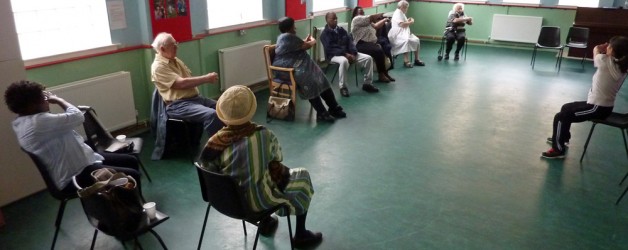
A generic Care of the Elderly exercise class.
These classes have had a similar format for years with a ‘safe chair’ and low intensity and volume movements it is no surprise that rate of falls are not falling. Below is a link for an NHS page.
It promises ‘Performing these gentle sitting exercises will help improve your mobility and prevent falls, and can even be done at home’
http://www.nhs.uk/LiveWell/fitness/Pages/sitting-exercises-for-older-people.aspx
These seated exercises will not prevent falls. None of the available evidence or research suggests that 5 lifts of each knee whilst sitting on a chair will prevent a fall.
Should elderly exercise look more like this? And be based in a leisure centre or gym rather than a hospital unit?
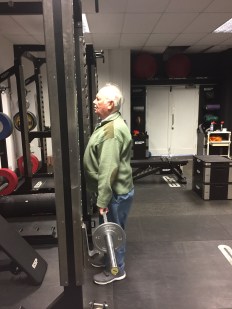
One of my patients learning to dead lift
It is time to rethink elderly exercise programming and perform needs analyses as we would any athlete or rehabilitation patient. ‘Old’ is simply not an analysis. It could lead us to investigate certain physiological processes which may or may not be problematic but it should not be the end of our consideration.
When the reasons for falling are examined and management is attempted the NHS spends millions on rails, flooring, removal of obstacles, fall monitors and detectors etc. However, apart from few unloaded exercises over 6 weeks and a cup of tea very little seems to be being done to reduce the internal causes of falling.
It does seem that a large proportion of falls occur as an inability to recover from a trip (Pijnappels, Reeves, Maganaris, & van Dieën, 2008) or a tumble downstairs (LaStayo, Ewy, Pierotti, Johns, & Lindstedt, 2003). In 2003 more than 51,000 elderly attended NHS emergency departments for staircase related falls (DTI, 2003). As previously thought to be due to obstacles, eyesight and vestibular degeneration but also a probable decreasing ability for submaximal controlled eccentric contraction (LaStayo, Pifer, Pierotti, & Lindstedt, 2008).
Pijnappels (2008) found that in young people tripping, or when failing to clear uneven floor with the swing leg, it takes 60-80ms for triceps surae and the hamstrings to attain appropriate force development. This extensor force has to overcome hip flexion and knee extension and generate a plantar flexion and hip extension moment in the support leg to counteract the forward momentum of the body as the lead leg is stopped by paving. This gives the lead leg enough time to recover balance.
In the elderly, tripping is more likely to occur due to a lower median (not mean) minimal foot clearance than a younger person (Pijnappels et al., 2008) This low foot clearance can cause tripping just by the swing phase foot hitting uneven floor. Due to this we need to be diligent in assessing and addressing the physiological reasons for failure to recover from tripping not just try to ‘sanitise’ the older person’s home. The removal of clutter and obstacles does have its place but failure to provide physiological change can decrease physically and psychologically the elderly person’s safety zone. Which in turn will decrease opportunity for activity and socialising.
Normal aging is a progressive process physiologically typified with loss of spinal motor neurones due to apoptosis (Aagaard, Suetta, Caserotti, Magnusson, & Kjær, 2010; Yu, 2015) which may be correlated with, or cause loss of muscle tissue with a decrease in size and number of fibres known as sarcopenia (Aagaard et al., 2010; Scott, Blizzard, Fell, & Jones, 2011), along with changes of fascicle length and pennation angle (Narici, Maganaris, Reeves, & Capodaglio, 2003). This causes muscle atrophy and a decrease in strength (Narici, Maganaris, & Reeves, 2005) . These physiological micro-changes cause a reduced functional capacity of the tissues and corresponding decrease in movement literacy and variation which leads to poor balance and falling. We know that biomechanically, force development time in the muscle is significantly longer (Pijnappels et al., 2008; Sayers & Gibson, 2014), too long for reactive peak force development with the peak moment being less. Also, the tendons themselves lose about 15% of their inherent ‘stiffness’ due to collagen changes so are less able to store vital energy and transmit high forces to the muscle (Narici et al., 2005).
Strength training appears to elicit effective countermeasures to muscle sarcopenia in elderly individuals even at a very old age (>80 years) by evoking muscle hypertrophy along with substantial changes in neuromuscular function, respectively (Aagaard et al., 2010; Persch, Ugrinowitsch, Pereira, & Rodacki, 2009; Pijnappels et al., 2008; Roig et al., 2009)
In 1994 Fiatrone et al studied 100 nursing home residents with the intervention group completing high intensity resistance training several times a week over 10 weeks. Those trained had a 28% increase in stair walking speed and 12% increase in maximum walking speed. Muscle strength and muscle CSA also increased in this group so we would assume that strength and hypertrophy had improved the function although this does not take into account measurement of proprioceptive changes (Zheng et al., 2013) or cognitive changes (Cassilhas et al., 2007).
So we understand that doing 3 x 10 marching in a chair is absolutely not going to make any improvements to the strength or balance of an elderly person and current research suggests that the elderly population can and should do resistance exercise but what would be the most effective dosage to attenuate the effects of aging and consequently failure to recover from tripping? If we look again at our goals
· Increase rate of force development and peak moment in lower limb.
· Increase eccentric control of quadriceps coming downstairs.
· Improve proprioception and coordination
· Improve vestibular function
· Ensure correct prescription eyewear if appropriate
So what does a program to specifically address these movement dysfunctions look like?
If we consider our primary goal a simple rate of force development curve can drive part of our exercise prescription. Although resistance training (RT) improves hypertrophy, strength and peak force understanding that we need to increase the speed at which muscle contraction occurs means a predilection towards velocity over force improvement as a driver of power. In 2014 Sayers and Gibson programmed a group of elderly people with 12 weeks of high speed power training comparing it to a standard resistance program. They believed it was critical to find the %RM at which peak power was achieved. They trained one cohort in high speed power training at 40% 1RM whilst the heavy resistance group trained at twice that resistance. The high speed group improved their power at a decreased resistance which meant there was a corresponding increase in velocity.
This was exactly what was required to avoid succumbing to the forces of gravity and mass in propelling a tripping body forwards and also fast foot braking in a car (Sayers & Gibson, 2012). This is in some contrast to the superior force required to slowly move a heavy object.
To address our secondary goal the work of LaStayo et al (2003) provides a compelling argument for high force producing eccentric quadriceps activity. He advocates this ‘negative work’ especially in those elderly who may be exercise intolerant due to cardiovascular pathology. Because of the low energy cost and low perceived exertion of this eccentric muscle activity it is ideal for the ill elderly. The outcome of this attractive program was a 60% improvement in strength over the 11 weeks of the study and 60% increase in cross-sectional area of the muscle. Beyond these numbers and more importantly the fall risk of all participants was decreased from high to low which shows the exercise specificity to function.
Although most of the studies and research were performed on flywheel type exercise equipment or machine weights, there is no reason not to use free weights with this section of population. Free weights could help to provide greater specificity to most activities of daily living and is something that could be partially replicated to provide a comprehensive home exercise program.
Before beginning a training program the client should have visited their GP and been cleared to exercise before participation. They should have consulted optician to ensure appropriate corrective eyewear. They should have a comfortable, sturdy shoe or trainer. It is important to carry out
· A musculoskeletal assessment
· Thorough past medical history
· Drug history
· Training history
· Contextual red flags must be checked
· Pulse and blood-pressure taken and recorded.
· Needs analysis.
Below is a small sample of exercise ideas for an elderly person with a minimum/moderate fall and trip risk but mobile and self-caring. The fictitious patient has recently moved into a very small ground-floor flat from a large house with less opportunity for pottering or for going up and down stairs. They been leaving the house infrequently due to unfamiliarity with the area. They have no cardio-vascular pathology but some vestibular balance problems (very common in over 75s) that need addressing with Brandt and Daroff exercises. The vestibular problems would be assessed by an Ear Nose and Throat specialist doctor and a Chartered Physiotherapist with a special interest in Benign Paroxysmal Positional Vertigo (BPPV) but can be carried out as a home exercise.
The client should be monitored carefully whilst completing the program for any signs of illness, cardiovascular complications, excessive fatigue or dizziness.
The warm up is a time to talk to the client, make them feel comfortable and allay any fears about the difficulty of the program. They should not get excessively short of breath or feel ill.
The warm up overhead squat should have as many reps as you feel appropriate. This will give you a feel for their range of movement at ankle, knee, hip, back, thoracic spine, neck and shoulders in one fantastic mobilising exercise.
The single leg eccentric hack squat should be a high force exercise. This will enable better quadriceps control descending stairs and ramps. The eccentric nature of the contraction means the client will not perceive the work as overly tiring. There is also some evidence that 60-80%1RM can improve memory and information processing speed possibly by IGF1 (insulin-like growth factor protein) production (Chang, Pan, & Chen, 2012)
Knee extension concentric contraction must be done as quickly as possible with a slightly slower eccentric contraction. This will increase power by increasing velocity. There should be some carry over to the recovery reflex in the event of tripping.
Single leg calf raises again should be done quickly. There is good dynamic correspondence to the forced ankle plantar flexion moment in trip recovery. Plus balance training if they can do without holding onto a support.
The Brandt and Daroff exercises are a home exercise that needs to be done regularly. Adding this into the program will ensure correct execution and home compliance.
References
Aagaard, P., Suetta, C., Caserotti, P., Magnusson, S. P., & Kjær, M. (2010). Role of the nervous system in sarcopenia and muscle atrophy with aging : strength training as a countermeasure. Scandinavian Journal of Medicine and Science in Sports, 20, 49–64.
Age UK. Stop falling: start saving lives and money. http://www.ageuk.org.uk
Cassilhas, R., Viana, V., Grassmann, V., Santos, R., Santos, R., Tufik, S., & Mello, M. (2007). The Impact of Resistance Exercise on the Cognitive Function of the Elderly. Medicine & Science in Sports & Exercise, 1401–1407.
Chang, Y., Pan, C., & Chen, F. (2012). Effect of Resistance-Exercise Training on Cognitive Function in Healthy Older Adults : A Review Resistance-Exercise Training. Journal of Aging and Physical Activity, 20, 497–518.
Department of Trade and Industry (DTI), 2003. 24th (Final) Report of the home and leisure accident surveillance system (Department of Trade and Industry: London).
Fiatrone, M. A., O’Neill, E. F., Ryan, N. D., Clements, K. M., Solares, G. R., Nelson, M. E., … Evans, W. J. (1994). Exercise training and nutritional supplementation for physical frailty in very elderly people. The New England Journal of Medicine, 330(25).
LaStayo, P., Ewy, G., Pierotti, D., Johns, R., & Lindstedt, S. (2003). The positive effects of negative work: increased muscle strength and decreased fall risk in a frail elderly population. The Journals of Gerontology. Series A, Biological Sciences and Medical Sciences, 58(5), M419–M424
LaStayo, P., Pifer, J., Pierotti, D., & Lindstedt, S. (2008). Electromyographic adaptations elicited by submaximal exercise in those naive to and in those adapted to eccentric exercise: adescriptive report. Journal of Strength and Conditioning Research, 22(3), 1–3.
Narici, M. V., Maganaris, C. N., & Reeves, N. D. (2005). Myotendinous alterations and effects of resistive loading in old age. Scandinavian Journal of Medicine and Science in Sports, 15(6), 392–401.
Narici, M. V, Maganaris, C. N., Reeves, N. D., & Capodaglio, P. (2003). Effect of Aging on Human Muscle Architecture. Journal of Applied Physiology, 95(6), 2229–2234.
Persch, L. N., Ugrinowitsch, C., Pereira, G., & Rodacki, A. L. F. (2009). Strength training improves fall-related gait kinematics in the elderly: A randomized controlled trial. Clinical Biomechanics, 24(10), 819–825.
Pijnappels, M., Reeves, N. D., Maganaris, C. N., & van Dieën, J. H. (2008). Tripping without falling; lower limb strength, a limitation for balance recovery and a target for training in the elderly. Journal of Electromyography and Kinesiology, 18(2), 188–196.
Roig, M., O’Brien, K., Kirk, G., Murray, R., McKinnon, P., Shadgan, B., & Reid, W. D. (2009). The effects of eccentric versus concentric resistance training on muscle strength and mass in healthy adults: a systematic review with meta-analysis. British Journal of Sports Medicine, 43(8), 556–568.
Sayers, S. P., & Gibson, K. (2012). Effects of high-speed power training on muscle performance and braking speed in older adults. Journal of Aging Research, 1–8.
Sayers, S. P., & Gibson, K. (2014). High-speed power training in older adults: A shift of the external resistance at which peak power is produced. Journal of Strength and Conditioning Research, 28(3), 616–621.
Scott, D., Blizzard, L., Fell, J., & Jones, G. (2011). The epidemiology of sarcopenia in community living older adults: What role does lifestyle play? Journal of Cachexia, Sarcopenia and Muscle, 2(3), 125–134.
Yu, J. (2015). The etiology and exercise implications of sarcopenia in the elderly. International Journal of Nursing Sciences, 2(2), 199–203.
Zheng, J., Pan, Y., Hua, Y., Shen, H., Wang, X., Zhang, Y., … Yu, Z. (2013). Strategic targeted exercise for preventing falls in elderly people. Journal of International Medical Research, 41(2).
 michellecuthbert